

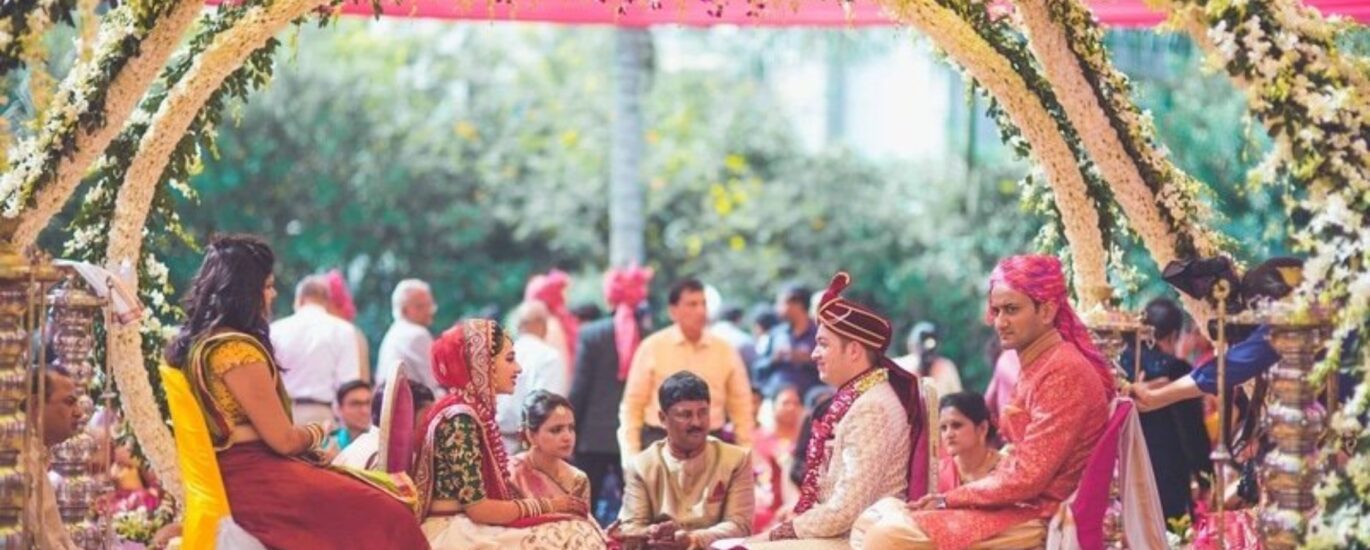
Hindu weddings are traditionally big, bright and colourful. They are a celebration of love and commitment and can also be a celebration of the couple’s religion and culture. Marriages, according to Hindu beliefs, are made in heaven and once you are married, the bond is supposed to last for seven lifetimes. Hindu weddings include a long process of rituals and traditions. These may take place over several days and each tradition and ritual has a deep philosophical and spiritual significance.
Traditionally, a Hindu wedding will take place over three days, however, this varies from family to family. There are three main ceremonies that you can expect:
- 1st Ceremony – The Ganesh Puja is otherwise known as the Mandap Muhurat & Pithi. This is often followed by a Mendhi night/Sangeet night. This is an intimate family gathering that begins the festivities.
- 2nd Ceremony – Grah Shanti which is also called a Sathak/Mandvo or Mamoru ceremony.
- 3rd Ceremony – The main wedding celebration. This is the main ceremony and all guests will be involved.
You may be invited to any of these three days or just the last day.
What are Hindu Wedding Traditions?
There are many different rituals at a Hindu wedding that will take place over several events. The precise details vary from region to region and often take several hours to complete.
Hindu wedding traditions are as follows:
- The Baraat / The Jaan
- Pokwanu – Welcoming of The Groom
- Ganesh Puja
- Vaarpooja
- Kanya Aagman – The Arrival of the Bride
- Granthibandan and Varmala
- Kanyadan
- Havan
- Mangal Fera
- Saptapadi – The Seven Steps
- Sindur & Mangal Sutra
- Akhand Saubhagyavati – Blessings From Married Women
- Aashirwad
- Vidaai
- End of the Ceremony
What are the Hindu Wedding Traditions?
Briefly mentioned above were the 15 Hindu wedding traditions that usually take place at a Hindu wedding. However, don’t be alarmed if you’re reading the titles still have no idea what they mean! We have given a brief description of what each Hindu wedding tradition consists of, so you can be fully prepared when arriving as a guest at a Hindu wedding.
The Baraat / The Jaan
The Baraat is where the festivities begin. In Hindu and Sikh weddings, the Groom is led to the marriage venue in a procession known as the Baraat. Usually, the Groom will be accompanied by family, groomsmen and friends are known as barratis. Typically the Groom will be on a horse or elephant with fantastic music which sets the mood for the rest of the marriage celebrations. These are often upbeat and exciting songs.
Pokwanu – Welcoming of The Groom
The Pokwanu is where the bride’s family formally welcomes the Groom and his guests. The Bride’s mother will apply a tilak on the Groom’s forehead and will then escort him and his family into the venue. Once inside, the priest will perform a brief ceremony. After this, the Groom will then be asked to smash a clay pot with his foot breaking it into pieces. This demonstrates his ability to overcome all obstacles the couple may face in married life. The Groom is then escorted into the Mandap.
Ganesh Puja
Lord Ganesh is the Hindu elephant God that removes all obstacles and during the Ganesh Puja the priest will invoke the God. This is a Hindu wedding tradition performed for good luck. The Ganesh Puja involves both the bride and groom’s primary family who are usually sitting on stage with them at the Mandap.
Vaarpooja
The Vaarpooja is where the bride’s parents perform a ceremony where they wash the groom’s feet, offer flowers and Madhuparka. At the end of the ceremony, a veil of cloth is held in front of the groom to prevent him from seeing the bride as she enters.
Kanya Aagman – The Arrival of the Bride
The bride will be escorted to the Mandap by her uncles. Once inside, verses are chanted as the veil is lowered and the couple exchange flower garlands. To declare that the bride has chosen the groom of her own free will, she will offer the flower first. To return the compliment, the groom will then offer his flower garland.
Granthibandan and Varmala
The bride and groom will chant prayers to Lord Shiva, Goddess Parvati, Lord Narayan and Goddess Laxmi Devi, asking for marriage as strong as theirs. The groom’s scarf will be tied to the bride’s shawl and the knot symbolises two souls joined together.
Kanyadan
This is where the bride’s parents give away their daughter to the groom.
Havan
The Havan is a sacrificial fire tradition. It is performed in a square-shaped Kunda, which combines the vertical element of fire with the horizontal elements of fire and earth. Often ghee, rice and flowers will be put into the flame.
Mangal Fera
This is where the couple circles the holy fire four times as the priest chants Mantras. The first three of the circles are led by the groom, whilst the fourth is led by the bride. This is to signify balance within the marriage. Once complete, the bride and groom race back to their seats. As part of the Hindu wedding tradition, it is said whoever sits in their seat first will be the ruler of the household.
Saptapadi – The Seven Steps
The Saptapadi (the seven steps) is the most important Hindu wedding tradition. After tying the Mangalsutra, the newlywed couple takes seven steps around the holy fire. Once completed, the couple legally becomes husband and wife.
Sindur & Mangal Sutra
The Sindur and Mangal Sutra is where the ceremonies begin where both the bride and groom are identified as married. The Sindhoor is placed at the parting of the bride’s hair to signify she is now a married woman, whilst the Mangal Sutra is a golden necklace placed around the bride’s neck to show love, respect and integrity.
Akhand Saubhagyavati – Blessings From Married Women
This is the part of the Hindu wedding ceremony when already married women are now invited to greet the couple and whisper blessing into the bride’s ear.
Aashirwad
The newlyweds then seek blessings from the priest, relatives and friends.
Vidaai
One of the most recognisable moments of a Hindu wedding ceremony is the Vidaai. This is where the bride’s family bid farewell to their daughter as she rides away with her new husband. This is one of the most emotional Hindu wedding traditions. As the bride walks out of the wedding venue she is given a handful of rice and sometimes coins, which she will throw over her head as she leaves. This symbolises a repayment to her parents for all they have given her throughout the years.
End of the Ceremony
This may be the end of the ceremony, but it is in no way the end of the party! It is now time to go onto the Hindu wedding reception which is where you will enjoy great food, drinks and dancing.

